


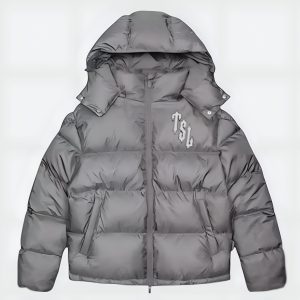
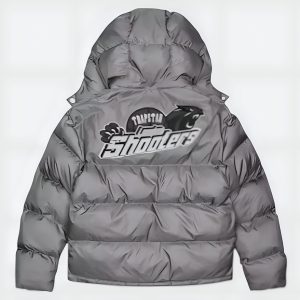
The Hyperdrive Puffer — what the construction spec actually delivers
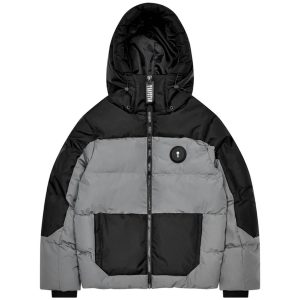
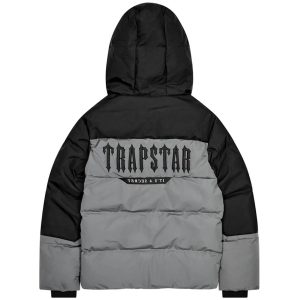
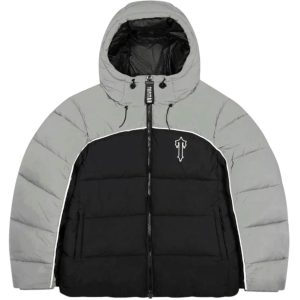
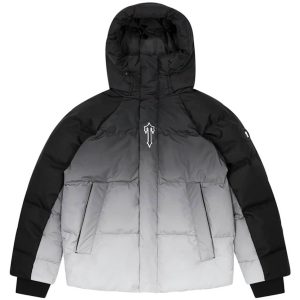
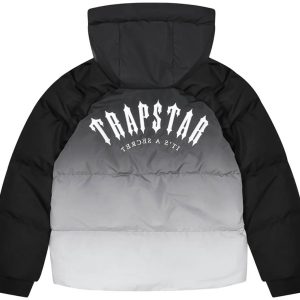
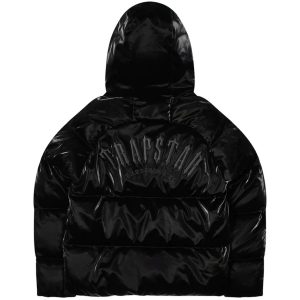
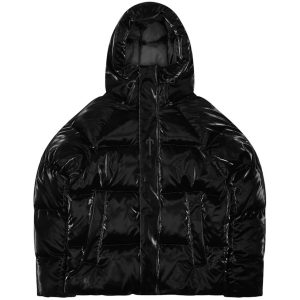
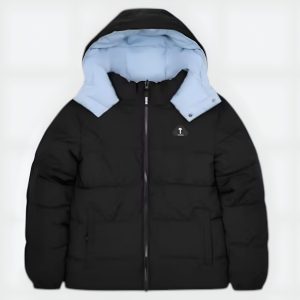
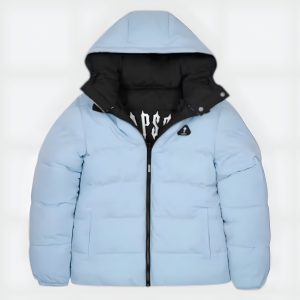
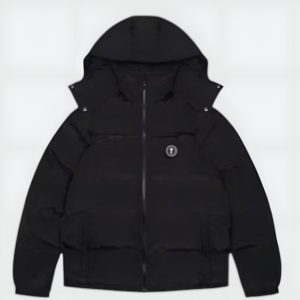
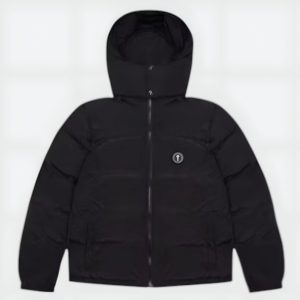
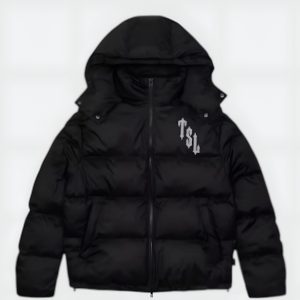
The Trapstar Hyperdrive Puffer is named for a specific construction approach — hyperdrive baffles, which are a quilted channel geometry that differs from standard horizontal baffling in how the fill is distributed across the jacket body. Standard horizontal baffles run parallel lines of stitching across the jacket from side seam to side seam, creating horizontal tubes that contain the fill. The fill in horizontal baffles migrates toward the lowest point of each tube under gravity during wear and storage — the fill concentrates at the bottom of each baffle channel rather than remaining evenly distributed across the full baffle width.
Hyperdrive baffles use a diagonal or geometric stitch pattern that creates smaller, more enclosed fill chambers rather than open horizontal tubes. The smaller chamber size limits the distance the fill can migrate in any direction before it reaches a stitch wall — fill migration is contained within a smaller zone per chamber, which means the overall fill distribution across the jacket face remains more consistent than in a standard horizontal baffle construction. The warmth consequence is a more even thermal performance across the full jacket surface — no cold spots where fill has migrated away from the stitch boundaries and no dense warm zones where it has accumulated.
The fill itself uses a synthetic polyester fibrefill rather than down — a deliberate choice for the UK climate context. Down fill has higher warmth-to-weight ratio than synthetic at equivalent fill weights, but down loses virtually all of its insulating capacity when wet. Wet down clusters mat together and cease to trap air in the loft structure that produces warmth. Synthetic fibrefill retains approximately 60–70% of its insulating capacity when wet because the polyester fibres do not mat under water in the way down clusters do. In a climate where rain is persistent and often horizontal, synthetic fill is the correct specification for a jacket that will be worn regularly outdoors rather than kept dry at all times.
The outershell of the Hyperdrive Puffer uses a DWR-treated ripstop nylon. DWR — Durable Water Repellency — is a chemical treatment applied to the outershell fabric surface that causes water to bead and roll off rather than being absorbed into the fabric. The DWR treatment does not make the jacket waterproof — water will penetrate through sustained heavy rain. It makes the jacket water-resistant for light to moderate precipitation, which covers the majority of the rainfall events that West London produces. The ripstop nylon outershell beneath the DWR treatment provides the tear resistance described in the jacket's name — the reinforcing thread crosshatch woven into the base nylon prevents small punctures or abrasion marks from propagating into larger tears.
Three Trapstar jacket formats — the weather problem each one solves
Each Trapstar jacket format is built around a specific outdoor condition. The correct jacket is the one whose designed condition matches the conditions you actually wear it in.
The coaches jacket in streetwear — why the format works as a cultural object
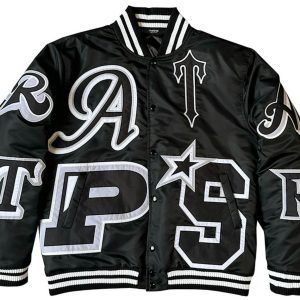
The coaches jacket format — snap-button or zip front, woven nylon or polyester outershell, often with a contrasting lining — has its origin in sideline sports culture: the jacket worn by the coaching staff during games, designed for visibility, brand identification, and weather protection without restricting movement during the intermittent physical activity of the coaching role. The format was adopted into streetwear through the same pathway as the track jacket — athletic wear that crossed into casual use because the visual language of organised sports had become aspirational rather than merely functional in the cultural contexts that produced streetwear.
The coaches jacket works as a streetwear piece specifically because it looks over-specified for the conditions it is worn in — a jacket designed for sideline duty at a professional sports event, worn on a high street in West London. The deliberate over-engineering signals something about the wearer's relationship to the athletic aesthetic: not athletic participation, but athletic affiliation. The Trapstar Irongate Coaches Jacket carries this affiliation into the brand's specific cultural territory — not a generic sports affiliation, but the specific intersection of music, street culture and athletic visual language that defines Trapstar's identity.
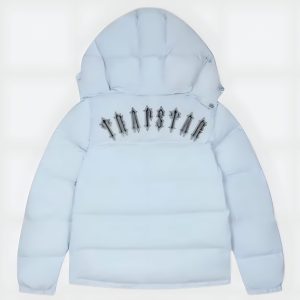
The Irongate arch on the coaches jacket chest is embroidered rather than screenprinted on most versions — the woven nylon outershell of the coaches jacket supports embroidery more reliably than screenprint because the tighter weave of the outershell fabric provides better stitch anchorage than the looser weave of a standard T-shirt or hoodie fleece. Embroidery on the coaches jacket chest reads at the same cultural register as embroidery on the chenille hoodie — craftsmanship through textile process rather than ink application. The graphic method matches the jacket format's aesthetic of deliberate over-engineering.
How the Irongate arch adapts to outerwear construction materials
The same Irongate arch graphic reads differently depending on the material it is applied to — not because the arch changes, but because different graphic methods produce different visual registers and those methods are determined by the outershell material of each jacket type.
Puffer — Chest embroidery
The quilted outershell surface of the puffer creates a textured ground that makes screenprint adhesion inconsistent across the graphic area. Embroidery at the chest stitches through both the outershell and the interlining, anchoring the thread in both layers for a stable, permanent graphic that does not lift at the edges as the jacket compresses and expands during wear.
Coaches — Woven chest embroidery
The tightly woven nylon outershell of the coaches jacket provides better stitch anchorage than looser cotton weaves. The Irongate embroidery on the coaches jacket chest sits flatter and maintains sharper edge definition than the same embroidery on a cotton fleece base — the tight weave prevents the surrounding fabric from distorting around the stitch boundary under the embroidery's pull.
Windbreaker — Back screenprint
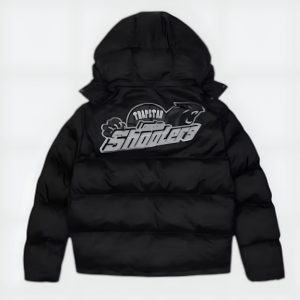
The lightweight windbreaker outershell at 80–100 GSM is too light for embroidery at back-panel scale — the stitch tension would distort the outershell geometry. Screenprint with plastisol or heat-transfer vinyl carries the Shooters graphic across the full back panel without the distortion risk. The graphic method at this outershell weight produces a clean, flat graphic rather than the tactile raised surface of the heavier pieces.
DWR coating on the Hyperdrive Puffer — what it does and what it does not do
DWR — Durable Water Repellency — is a factory-applied chemical treatment on the Hyperdrive Puffer outershell that causes water to bead and roll off the fabric surface rather than being absorbed into the nylon weave. The treatment works by reducing the surface energy of the nylon fibres — water molecules, which are attracted to surfaces with higher energy levels, slide off the treated surface rather than spreading across it and penetrating through to the fill layer.
Two things reduce DWR effectiveness over time: abrasion and contamination. Abrasion physically removes the DWR molecules from the treated nylon fibre surface — the areas where a jacket experiences the most contact during wear, typically the shoulders and forearms, lose DWR effectiveness faster than the body panels that experience less friction. Contamination from body oils, detergent residue and environmental particulates coats the fabric surface and reduces the surface energy differential that makes the DWR treatment work — effectively clogging the treated surface with material that does not repel water.
DWR can be reactivated and partially restored by tumble drying the jacket on low heat for 20 minutes — the heat reactivates the DWR molecules remaining on the fabric surface and repositions them on the fibre. This is one of the rare cases where tumble drying on low heat is the correct treatment rather than the wrong one. For the Hyperdrive Puffer specifically — the synthetic fill and the DWR treatment both tolerate low-heat tumble drying, though the rhinestone or embroidery elements on the chest require the jacket to be turned inside out even for this process. When DWR effectiveness has degraded to the point where the fabric wets out (water spreading rather than beading) after a wash-and-dry cycle, a DWR reproofing spray applied to the clean, dry outershell surface restores the treatment for another extended period of use.
Sizing Trapstar jackets — base layer determines the correct size
All three Trapstar jacket formats follow British sizing conventions — consistent with the hoodie and T-shirt range. What changes between jacket formats is the base layer each one is designed to accommodate.
| Jacket | Designed base layer | Order if base layer is T-shirt | Order if base layer is hoodie |
|---|---|---|---|
| Hyperdrive Puffer | T-shirt + hoodie underneath | Size up two from standard | Size up one from standard |
| Irongate Coaches | T-shirt or thin knit | Standard size | Size up one — coaches jacket does not have puffer volume |
| Shooters Windbreaker | T-shirt only | Standard size | Do not layer over hoodie — windbreaker shell has no accommodation volume |
The Hyperdrive Puffer is the only Trapstar jacket designed to accommodate a Trapstar hoodie as an inner layer. Its quilted body has sufficient internal volume for the hoodie's heavyweight fleece beneath it without pulling at the chest or restricting arm movement. The coaches jacket and windbreaker are designed for T-shirt base layers — forcing either over a heavyweight hoodie produces the same result as any shell jacket over a heavyweight base: chest restriction and an inability to close the front correctly.
Caring for Trapstar jackets — three formats, three protocols
Hyperdrive Puffer
Machine wash cold on a gentle cycle, turned inside out. The synthetic fill is wash-stable — it does not mat under water the way down does. Tumble dry on low heat with two tennis balls in the drum — the balls break up fill clumps that form as the synthetic fibres dry. This is correct protocol for the puffer specifically. Without the tennis balls the fill dries unevenly and creates cold spots. The DWR coating benefits from the low-heat drying cycle — heat reactivates the DWR treatment on the outershell surface.
Irongate Coaches Jacket
Machine wash cold on a gentle cycle, turned inside out, snap buttons fastened. Fasten all snaps before washing — open snap components rattle against the drum and the jacket lining during the wash cycle, causing surface marks on the lining fabric. Do not tumble dry — nylon outershell loses dimensional stability under sustained heat. Air dry hung from the collar on a wide-shoulder hanger. The embroidery on the chest is wash-stable — the woven nylon backing beneath it is not affected by cold washing.
Shooters Windbreaker
Machine wash cold on a gentle cycle, turned inside out, zip fully closed. The lightweight 80–100 GSM outershell is the most vulnerable to mechanical damage during washing — the gentle cycle reduces agitation that can stress the lightweight fabric at the seam attachment points. Do not tumble dry at any heat — the outershell at this weight will lose dimensional stability under dryer temperatures. Air dry flat rather than hung — the lightweight outershell can stretch out of shape under its own wet weight when hung before it has dried.
Frequently asked questions about Trapstar jackets
What are hyperdrive baffles and why do they matter?
Hyperdrive baffles are a quilted channel geometry that uses a diagonal or geometric stitch pattern rather than standard horizontal lines — creating smaller, more enclosed fill chambers that limit fill migration in any direction. Standard horizontal baffles allow fill to migrate toward the lowest point of each horizontal tube under gravity, creating cold spots where fill has moved away. Hyperdrive baffles contain fill migration within a smaller zone per chamber, producing more even thermal distribution across the full jacket surface.
Why does the Hyperdrive Puffer use synthetic fill rather than down?
Synthetic fill retains approximately 60–70% of its insulating capacity when wet. Down fill loses virtually all insulating capacity when wet — the down clusters mat together and cease to trap the air loft that produces warmth. In the UK climate where persistent damp cold and horizontal rain are regular outdoor conditions, synthetic fill is the correct specification for a jacket worn regularly outdoors. Down is the correct choice when the jacket will remain dry — synthetic is the correct choice when it will not always be dry.
What is the difference between the Irongate Coaches Jacket and the Shooters Windbreaker?
The coaches jacket uses a structured woven nylon outershell in the 150–200 GSM range with a contrasting lining — it has visual structure and holds its shape when unzipped or laid flat. The windbreaker uses a lightweight technical shell at 80–100 GSM that prioritises packability and minimal weight over structure. The coaches jacket is a mid-weight outerwear piece for cool dry conditions. The windbreaker is an emergency wind and light rain layer that packs small enough to carry as a precaution. Both use the Trapstar graphic identity — the coaches jacket through chest embroidery, the windbreaker through back panel screenprint.
Can I wear the Trapstar puffer over the Trapstar hoodie?
Yes — the Hyperdrive Puffer is the only Trapstar jacket designed to accommodate the Trapstar hoodie as an inner layer. Size up one from your standard size when layering the hoodie underneath. The coaches jacket and windbreaker are not designed for a hoodie base layer — their internal volume does not accommodate the heavyweight fleece without pulling at the chest and restricting movement.
What is DWR coating and does it wear off?
DWR — Durable Water Repellency — is a chemical treatment on the Hyperdrive Puffer outershell that causes water to bead and roll off rather than penetrating the fabric. It degrades over time through abrasion and contamination. It can be reactivated by tumble drying the jacket on low heat for 20 minutes — one of the rare cases where low-heat tumble drying is the correct treatment. When significantly degraded, a DWR reproofing spray applied to the clean dry outershell restores the treatment. DWR makes the jacket water-resistant for light to moderate precipitation — not fully waterproof in sustained heavy rain.
What size should I order in a Trapstar jacket?
All Trapstar jackets follow British sizing conventions — consistent with the hoodie and T-shirt range. For the Hyperdrive Puffer: size up one if layering over a T-shirt base, size up two if layering over a hoodie. For the coaches jacket: standard size for T-shirt base, size up one for a thin knit base. For the windbreaker: standard size for T-shirt base only — do not attempt to layer the windbreaker over a hoodie. If you already own a Trapstar hoodie and want the puffer to fit over it, order two sizes up from your hoodie size.
Fragment Clothing stocks the complete Trapstar jacket range. Three formats. Three weather problems. One Irongate arch. Shipped worldwide.